


Ethereum is running out of money, according to former insiders.
The warning has sparked one of the fiercest Ethereum governance debates in months: should the network fund developers by taxing staking rewards, or just rely on wealthy Ether holders to bankroll its ecosystem?
At the center of the debate is a controversial proposal from Kleros co-founder Clément Lesaege. He suggested redirecting up to 10% of validator rewards to ecosystem funding through a protocol-level mechanism called Validator Redirected Revenue.
Lesaege argued that this may be necessary to solve Ethereum’s “coordination failure” and reduce the underfunding of shared ecosystem work.

The idea was met with a wave of backlash, with critics warning of cartel-like incentives and a dangerous precedent for validator-led redistribution.
Validator Redirected Revenue proposal. Source: Eth Research
But just as the Ethereum community was sharpening its knives, a “credibly neutral” solution was forming: Ethlabs.
Unveiled Monday by five former Ethereum Foundation researchers, the shiny nonprofit Ethereum research and development lab is backed by the ecosystem’s biggest supporters, including BitMine, Sharplink and ConsenSys founder Joseph Lubin.
Related: Ethereum Foundation sacks 20% of workforce amid strategic restructuring
With large investors ready to dig into their pockets, the real question becomes less about whether Ethereum can fund itself and more about how it wants to be funded.
Ethereum’s ‘slow-burning funding crisis’
The latest ETH drama began on Friday when former Ethereum Foundation contributor Trenton Van Epps warned that Ethereum’s core development ecosystem could face a “slow-burning funding crisis” within three to nine months as older support programs dry up and Foundation spending falls.
He estimated that maintaining more than 10 client, research and coordination teams costs roughly $30 million a year, and that the Client Incentive Program and other support mechanisms were no longer enough to cover that bill.
Van Epps argued that Ethereum is entering an institutional “inheritance” phase in which the Foundation will move away from being the primary steward of protocol funding, and that new arrangements must replace the expiring programs he helped coordinate.
Having spent much of the year dealing with leadership turnover, public criticism over priorities, and a growing debate over core protocol funding, Van Epps’ warning touched a raw nerve.
But some Ethereum voices pushed back, arguing that the EF has “enough funds to run for at least 30 years, so there is zero funding crisis.” Bitmine’s Tom Lee also rejected the warning, saying there was “zero chance” of Ethereum running out of funds for protocol development.

Ethereum Foundation Treasury Policy. Source: Ethereum Foundation
The Ethereum Foundation’s own treasury policy already points to a multi-year operating buffer and a planned reduction in annual spending.
In June 2025, the EF said it would maintain a 2.5-year operating expense buffer in cash and stablecoins, pledged to cap annual spending at 15% of total treasury assets and gradually reduce that spending rate toward a 5% baseline over five years.
Related: Ethereum can quantum-proof accounts for just 7 cents, says Ethereum’s Kohaku lead
On Tuesday, Ethereum founder Vitalik Buterin said the Foundation is decreasing its budget by roughly 40%, in line with that policy, as it transitions from spending around 15% of its funds annually before 2026 toward a long-term target of about 5% per year after 2030. It laid off 54 staff members.
The proposal everyone hates
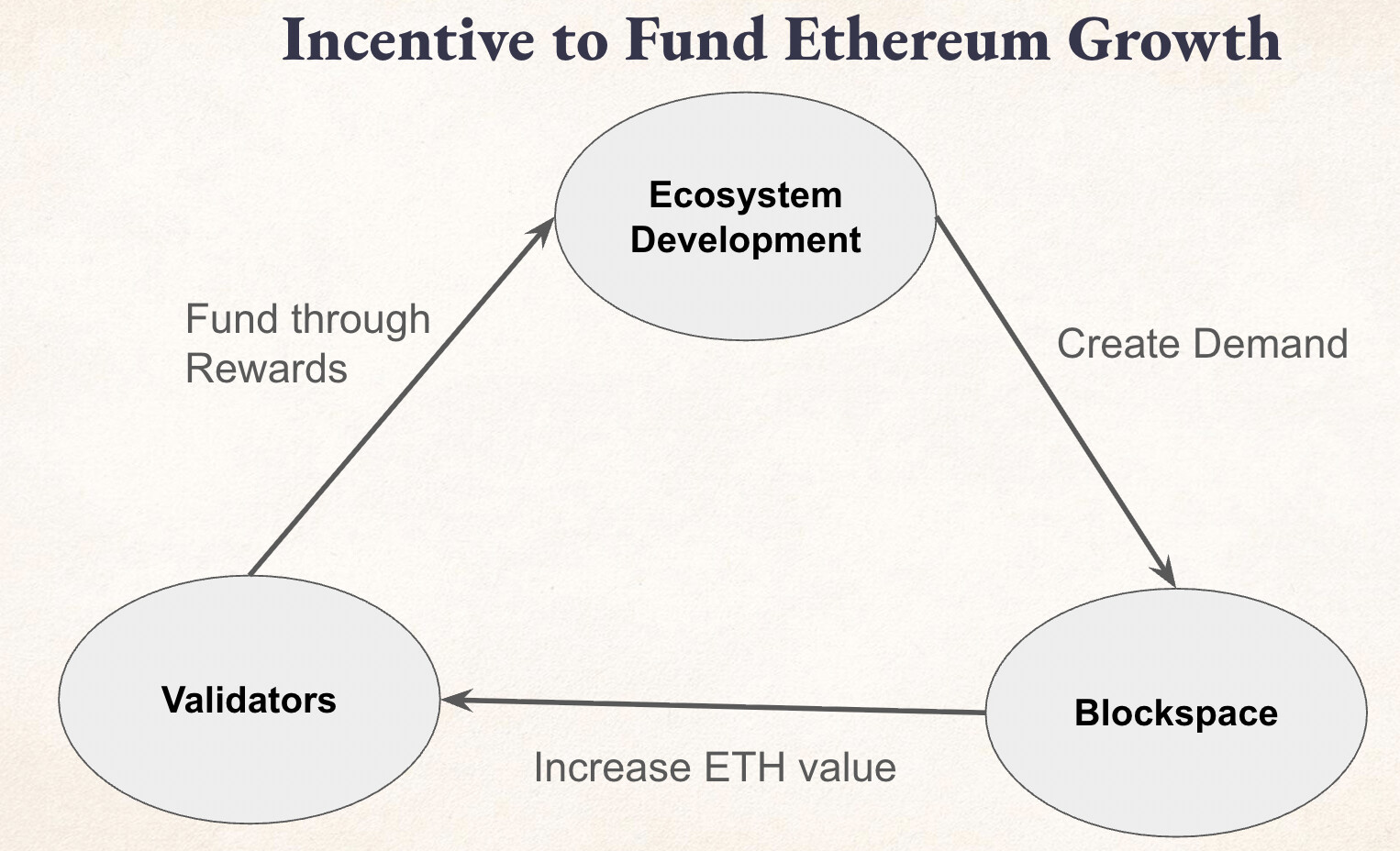
So the Foundation may not run out of money, but it is tightening its belt and has a lot less cash to spend on research and development than in its glory days. Lesaege argued that Ethereum suffers from a coordination failure in which everyone benefits from shared infrastructure — but no one wants to foot the bill.
His proposal would require validators to signal how much of their staking rewards they are willing to redirect, a figure between 0% and 10%. If a majority of validators supported a non-zero rate, that redirect would become mandatory for all.
At current staking levels, he estimated that even a 5%-10% redirect could generate roughly 50,000 to 70,000 ETH per year for ecosystem work, or roughly $82.5 million to $115.5 million at current ETH prices today.
Incentive to fund Ethereum growth. Source: Eth Research
Critics quickly zeroed in on the mechanism’s power dynamics, warning that it could entrench large validators, blur the line between operators and governance actors, and give a stake-weighted majority new leverage over ecosystem funding decisions.
What staking providers say
A spokesperson for Figment told Cointelegraph the proposal would compress margins, which “tends to consolidate the validator set toward larger, more integrated operators” serving institutional clients, like Figment.
This would come at the “cost of some operator diversity and potentially fewer net new ETH stakers,” the spokesperson said.
Andrew Gibb, chief executive and co-founder of Twinstake institutional staking, told Cointelegraph that various investor segments would respond differently.
While long-term ETH holders may value the prospect of a better-funded ecosystem, shorter-term capital, such as retail participants, liquid multi-asset funds and reward-focused allocators may be less receptive.
He said the proposal would “narrow the addressable staking market at the margin,” with the most price-sensitive cohorts likely to “reduce or exit positions,” adding that he would expect some clients to reassess their staking allocations.
Related: Buterin fires back at Ethereum Foundation critics, recommits to neutrality
Senior research associate at Bitwise, Max Shannon, told Cointelegraph that Ethereum staking participation has so far shown limited sensitivity to lower rewards.
He said that the staking annual percentage rate (APR) has fallen from about 4.6% in June 2023 to around 2.7% now, while staked supply and the staking ratio roughly doubled. However, additional reward compression would make “slashing risk and exit-queue liquidity risk more material relative to the return.”
He added that a lower net consensus-layer yield could push validators to rely more heavily on maximal extractable value (MEV) to make up lost APR, which could potentially weigh on censorship resistance.
How large is the problem, really?
On paper the funding gap is not that large. Shannon noted that if the annual shortfall is around $30 million and annual staking rewards are about $1.9 billion, so the gap could be filled with just 1.6% of staking rewards.
That makes Lesaege’s proposal look modest, even though it remains politically radioactive. In economic terms, a single-digit haircut on staking rewards is manageable. In governance terms, many Ethereum participants see it as a line-crossing move that turns validators into a tax authority.
Shannon also argued that networks with hard-coded development funding are not necessarily better off just because they earmark rewards. In his view, protocol success is driven far more by token performance and contributor incentives than by any one developer funding mechanism.
A new funding model emerges
Tom Lee’s comment there was “zero chance” of an Ethereum funding crisis and that funds were “secured” foreshadowed the unveiling of the new non-profit EthLabs a few days later.
Rather than taxing rewards at the protocol level, Ethlabs enables large ETH-aligned institutions such as BitMine and Sharplink to fund development directly.
Ethlabs nonprofit R&D for Ethereum. Source: Ethlabs
It does not replace the Ethereum Foundation, but complements it. EthLabs signals that the smart contract platform’s next phase may involve a more distributed funding model, where the EF remains central to the protocol’s core, while other labs and treasury-heavy institutions fund adjacent work.
In an X post on Monday, Ethereum co-founder Joe Lubin said there is still “an enormous amount of top tier talent” at the Ethereum Foundation that remain focused on “the cypherpunk core components” of the protocol. But he added that many other Ethereum R&D teams will now explore other dimensions.
Gibb said that the responsibility for funding ecosystem development sits with foundations and protocol treasuries. There are alternate mechanisms to explore, such as staking yield or priority fees, he added, “before making changes to validator economics at the protocol level.”
Whether Ethlabs proves sufficient remains to be seen. But its emergence has already shifted the debate from how Ethereum should tax itself to whether it needs to at all.
Market Moves: Why is Ethereum Foundation selling? BTC futures warning signs

