


Investors are withdrawing money from Hyperliquid-linked exchange-traded funds for the first time since the products launched.
Data from SoSoValue shows that the three funds have recorded more than $13 million in net outflows in July, putting them on course for their first negative month after attracting about $280 million since inception.
Nearly $27 million has left the products since demand reversed in the second half of July, ending a nine-week run of consecutive inflows, SoSoValue data show.
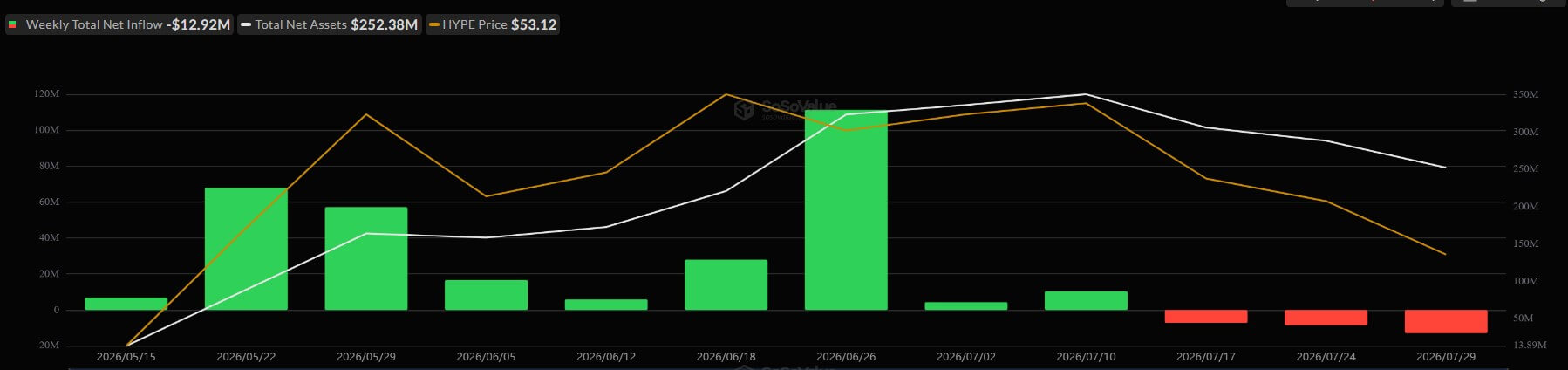
Data from CryptoSlate shows that the fund retreat has coincided with a more than 13% monthly decline in Hyperliquid’s HYPE token, which traded near $54 this week. This is roughly 30% below its mid-June record high of $76.

HYPE is now heading for only its second losing month this year, even as Grayscale Research argues that its price undervalues the revenue generated by the underlying network.
Grayscale sees a valuation gap despite weakening demand
The reversal in ETF flows is widening the divide between market sentiment and Grayscale’s assessment of the economics supporting HYPE.
Hyperliquid has crossed $1 billion in cumulative protocol revenue, less than two years after its launch, according to DeFiLlama data. The milestone came despite a broad crypto downturn and a volatile macroeconomic backdrop marked by inflation and geopolitical conflict.
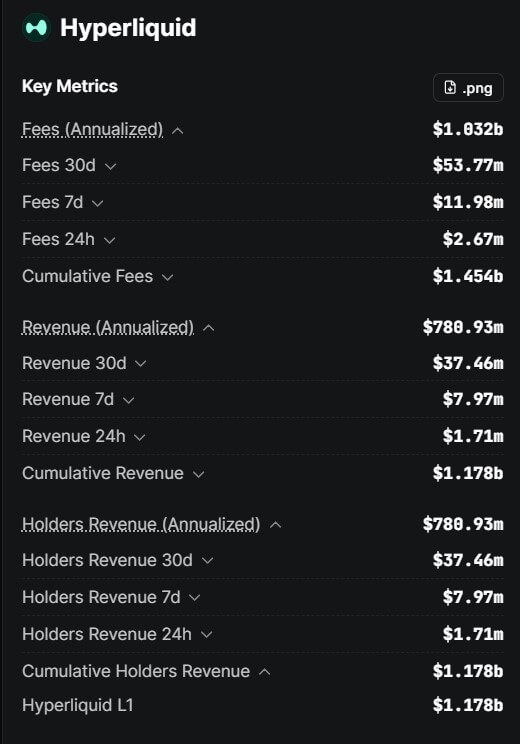
That operating record distinguishes HYPE from tokens whose valuations depend primarily on market narratives.
Hyperliquid generates fees through its decentralized perpetual-futures platform and uses most of that income to repurchase HYPE, creating a more direct link between trading activity and demand for the token.
Grayscale has attempted to quantify that relationship by adapting the earnings-per-share framework used for public companies into an “earnings per token” model. While HYPE does not represent equity in Hyperliquid, the asset manager argues that the protocol’s buyback mechanism allows its revenue to support the token’s value.
Grayscale estimates Hyperliquid could approach $1 billion in annual revenue by 2027, supported by a recovery in crypto trading and additional income from its stablecoin infrastructure.
The firm expects between 270 million and 310 million HYPE tokens to be circulating by the end of that year, depending partly on how quickly allocations to core contributors enter the market.
Those assumptions produce estimated earnings per token of about $3.25 to $3.75. At the price used in Grayscale’s analysis, HYPE was trading at roughly 15 to 18 times projected earnings.
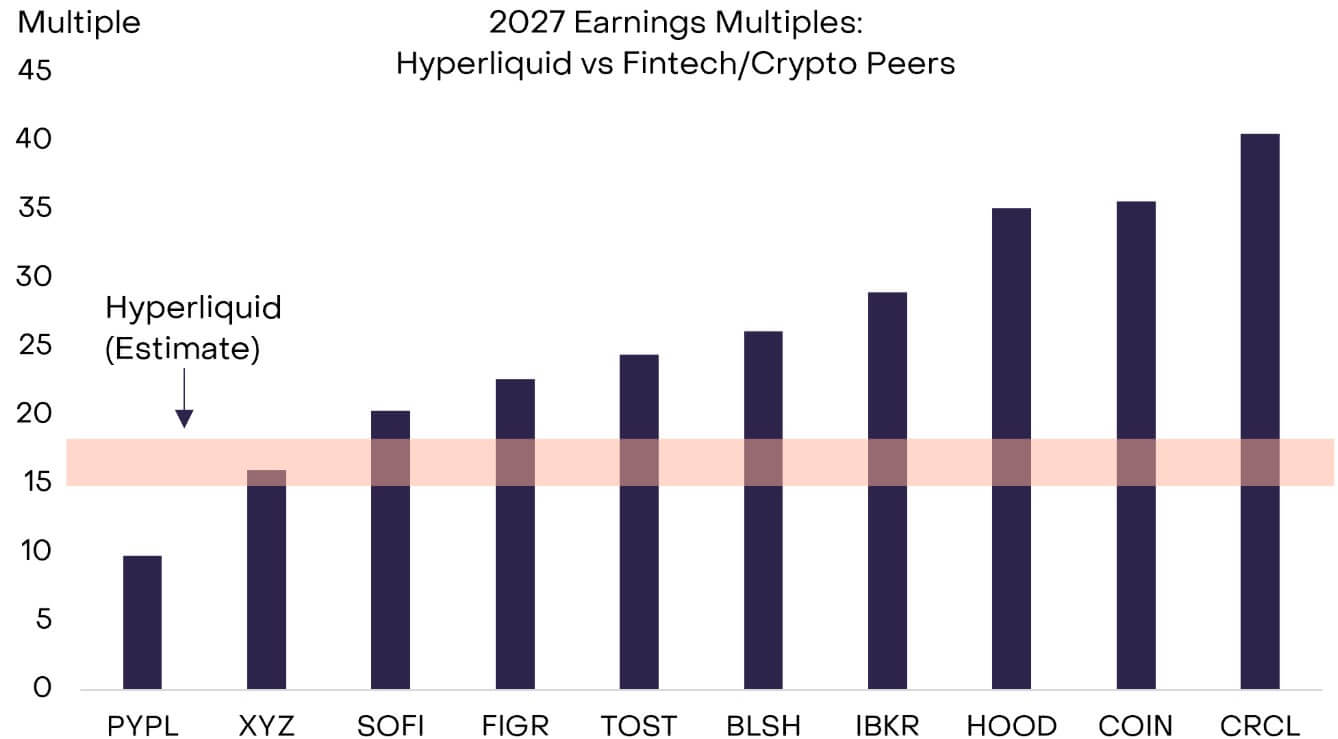
Grayscale Research Managing Director Zach Pandl compared that valuation with expected multiples of about 35 times earnings for Coinbase and 40 times for Circle. He added:
“On that basis, we think it looks cheap.”
However, this comparison has limits. HYPE holders do not own shares in Hyperliquid, and protocol revenue does not accrue to them in the same way corporate earnings benefit shareholders.
Grayscale’s valuation also depends on trading activity remaining strong, buybacks continuing and token supply staying within its projected range.
Traditional-asset markets broaden Hyperliquid’s growth case
Hyperliquid’s expansion into markets linked to stocks, commodities and indexes is beginning to reduce its dependence on crypto trading.
Perpetual contracts tied to traditional assets generated $25.1 billion in volume between July 13 and July 19, accounting for 52% of Hyperliquid’s $48.2 billion weekly total, Blockworks data show. It was the first time those markets had produced more activity than all other asset categories on the platform combined.
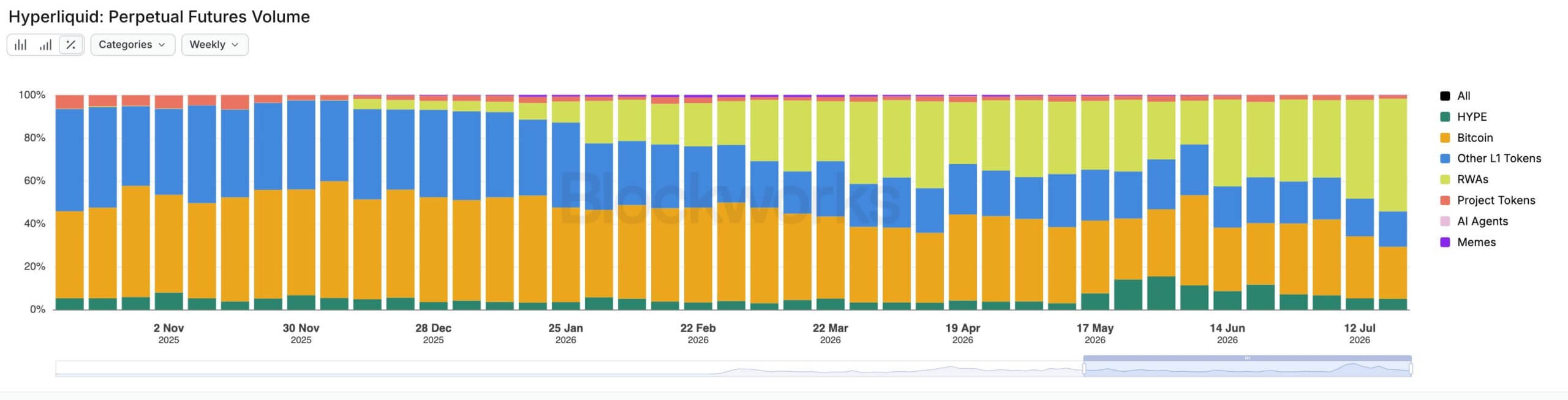
The contracts provide synthetic price exposure rather than ownership of the underlying assets. They operate through HIP-3, a framework that allows third-party developers to deploy perpetual markets using Hyperliquid’s trading infrastructure.
Their growth has also become significant relative to the wider decentralized derivatives market. ARK Invest digital-assets research director Lorenzo Valente said Hyperliquid processed about $50 billion of the $79 billion in perpetual-futures volume recorded across decentralized exchanges during the measured week. Roughly $26 billion came from its traditional-asset-linked markets.
Valente said that activity alone exceeded the combined crypto perpetual volume handled by every other decentralized exchange during the period.
Single-stock contracts have led the expansion. They have generated more HIP-3 volume than index and commodity markets since June and recently accounted for about 61% of activity tied to traditional assets, according to Valente.
The shift adds another dimension to Grayscale’s valuation argument. Hyperliquid can now collect trading fees from demand linked to corporate earnings, commodity prices and broader financial markets, rather than relying exclusively on speculation in Bitcoin, Ethereum and other digital assets.
That diversification does not guarantee that Grayscale’s revenue forecasts will be met. Weekly volume can be driven by temporary volatility, while the expansion into traditional-asset derivatives introduces regulatory, liquidity and market-structure risks that were less prominent when Hyperliquid concentrated on crypto.
Still, the expansion strengthens Grayscale’s argument that Hyperliquid can broaden its revenue base beyond conventional crypto trading.
For now, the platform’s business is expanding faster than investor appetite for its token. Grayscale sees that divergence as evidence that HYPE is undervalued, while July’s ETF outflows show that fund investors are becoming less willing to wait for the thesis to play out.