

This article first appeared in The Energy Mag. The original article can be viewed here. The Energy Mag (formerly The Miner Mag) provides news, data, and insights on the energy–compute–markets nexus.
The first installment of this Bitcoin-AI convergence series explored a foundational idea: Bitcoin mining was never just about digital currency. It was designed as a long-term energy system, converting electricity into computation.
The second installment examined how modern AI data centers are built on the same physical foundation as Bitcoin mining — chips, power, cooling, and infrastructure working together to turn electricity into compute at an industrial scale.
The third installment further explored how companies position themselves across digital innovation, from asset-light deployment and colocation (a shared infrastructure model) to infrastructure ownership, power integration, and full vertical integration.

Now, that convergence is playing out in real time across the industry.
During the first quarter of 2026, several major publicly traded Bitcoin miners — including Core Scientific (NASDAQ: CORZ), Cipher, and IREN — materially reduced portions of their Bitcoin mining operations, reallocating infrastructure and power capacity toward AI and high-performance computing software, applications, services or capabilities.
This shift was not merely about future positioning. It is already reflected in financial results.
With Bitcoin mining economics under pressure from historically low hashprice levels of mining revenue and rising network competition, AI and HPC infrastructure revenue has emerged as a stabilizing and, in some cases, significantly larger growth driver.
Core Scientific has continued accelerating the conversion of its infrastructure toward high-density colocation for CoreWeave (NASDAQ: CRWV). Cipher has shut down mining operations at portions of its Black Pearl facility after securing a long-term hyperscale AI lease. IREN, meanwhile, has increasingly repositioned itself as an AI cloud infrastructure operator, signing multi-billion-dollar processing and cloud service agreements while scaling back parts of its mining operations.
What has emerged is not simply a temporary diversification trend, but a broader restructuring of the Bitcoin mining industry itself.
The companies that once competed primarily on mining outcomes are increasingly being judged by a broader set of capabilities: infrastructure control, power access, cooling capacity and the ability to serve demand beyond Bitcoin alone.
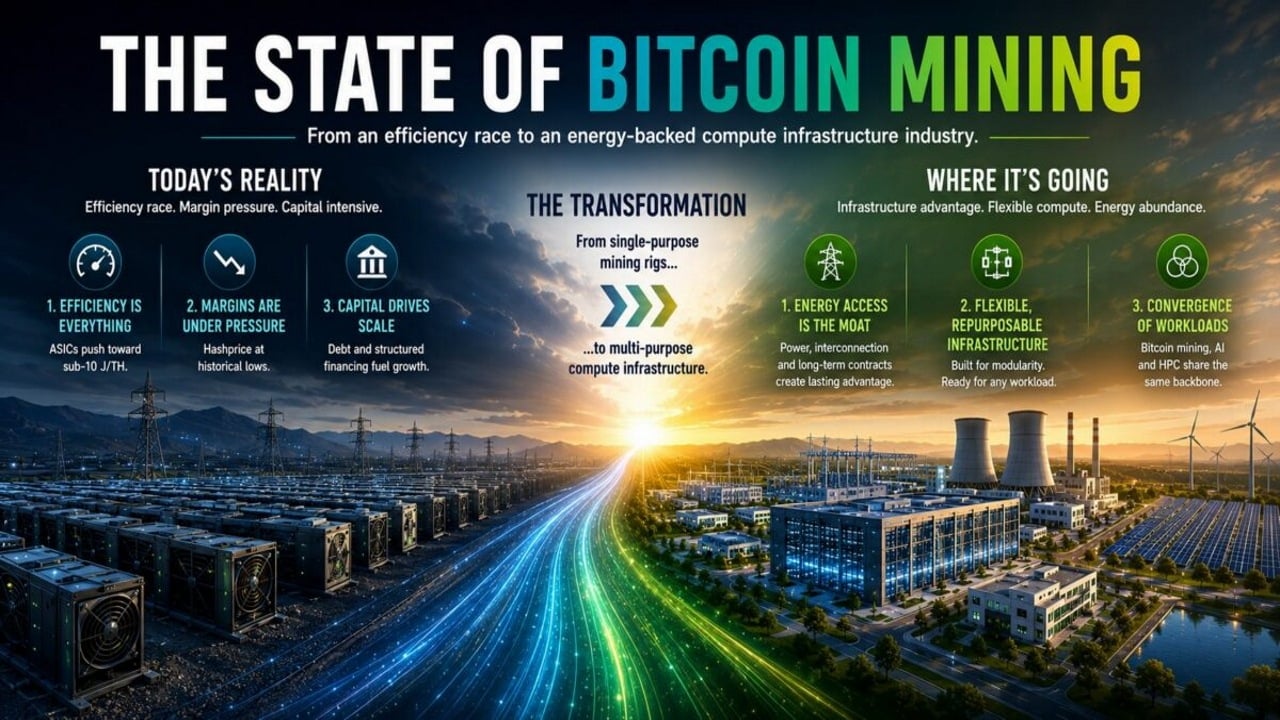
In other words, Bitcoin mining is evolving from a pure commodity hash business into a broader energy-backed compute infrastructure industry.
This final installment brings together the themes explored throughout this series:
- Bitcoin mining as an energy system
- The shared infrastructure stack between Bitcoin and AI
- The convergence of Bitcoin and AI business models
- And the growing importance of energy and infrastructure as strategic assets
The future relevance of Bitcoin mining is no longer defined simply by how much Bitcoin miners produce. It increasingly depends on how effectively operators deploy energy infrastructure across multiple compute markets.
The State of Bitcoin Mining Today
At first glance, Bitcoin mining still appears to revolve around a familiar metric: the rate of computational power and speed to secure blockchain, or hashrate. Even with Bitcoin’s notable price retreat since October 2025, the global Bitcoin network hashrate remains at over 900 EH/s (exahashes per second). For context, that is four times what it was four years ago and is still up around 50% since the Bitcoin halving in 2024.
But beneath that growth, the economics of mining are changing dramatically.
Over the past several years, microchip hardware has become exponentially more efficient. Compared to earlier generations of mining rigs in the past decade, leading-edge machines today are rapidly approaching efficiency levels 900% better.
That evolution has transformed mining into an operational efficiency race. As more efficient machines have come online globally, network competition has accelerated faster than Bitcoin price appreciation, placing sustained pressure on hashprice — the industry’s measure of mining revenue per unit of hashrate.
In earlier cycles, simply deploying more machines often translated into higher profitability. Today, scale alone is no longer enough. The operators gaining market share are increasingly those with access to low-cost power, efficient infrastructure, and disciplined capital allocation.
As a result, mining has also become significantly more capital-intensive, and public miners rely on structured debt, convertible notes, and infrastructure financing to fund expansion. The modern Bitcoin mining industry increasingly resembles infrastructure development as much as technology deployment.
Infrastructure as the Strategic Asset
As AI demand surges globally, the market has begun repricing access to power.
Grid-connected infrastructure — substations, transmission access, industrial campuses, and long-term power contracts — has become scarce and strategically valuable.
Sites originally built for mining are now attracting interest from AI and high-performance computing operators because they already solve one of the hardest problems in the data center buildout: getting large amounts of power to usable compute space.
In many regions, the hardest part of building modern compute infrastructure is no longer constructing the facility itself. It is securing electricity at scale — a problem that Bitcoin miners spent years solving through high-efficiency technology and alternative sources.
As a result, the industry is evolving beyond a pure mining business toward something broader: energy-backed compute infrastructure. This transition is already visible across the sector.
Companies that once focused exclusively on proprietary Bitcoin mining are now expanding into AI colocation, securing direct power-generation assets, and developing flexible compute facilities capable of supporting multiple workloads. The distinction between Bitcoin mining infrastructure and AI infrastructure is becoming less clear.
The Rise of Flexible Compute Infrastructure
One of the defining characteristics of modern mining infrastructure is flexibility.
Unlike traditional industrial facilities built for a single purpose, mining campuses are modular by design. Their core architecture is built around power distribution and high-density compute, making them easier to adapt as workloads evolve.
Those same characteristics make them suitable for AI and high-performance computing workloads. This flexibility matters because demand for AI infrastructure is evolving rapidly. Operators increasingly value infrastructure that can adapt between workloads rather than remain tied to a single application indefinitely.
In many cases, miners can immediately monetize newly secured power capacity through proprietary mining operations while simultaneously retrofitting infrastructure for higher-margin AI or colocation workloads over time. Rather than viewing Bitcoin mining and AI as competing industries, operators see them as complementary layers of the same energy-to-compute economy.
The Future Path
The future relevance of Bitcoin mining may ultimately depend less on the Bitcoin it produces and more on the infrastructure it creates.
Bitcoin remains the foundational economic engine that monetizes energy capacity immediately and globally. But the industry surrounding it is evolving.
The most successful operators so far resemble infrastructure companies, energy developers, and compute platform operators rather than pure Bitcoin producers.
As laid out in the third installment in this series, major industry players are moving toward full vertical integration, owning everything from the power plant to the workload running on top of it. In practice, convergence means a single business model that stretches from electrons to infrastructure to compute revenue.
In this model, Bitcoin mining becomes one layer within a larger energy-backed compute ecosystem. And in many ways, that evolution reflects the industry’s original trajectory all along.
Bitcoin mining was one of the earliest large-scale systems designed around converting electricity directly into digital computation at a global scale. Long before AI infrastructure became the dominant technology narrative, miners were learning how to arbitrage power markets, deploy infrastructure quickly and squeeze more compute from every watt.
The rest of the computing industry is now running into the same problems miners spent a decade solving.
What this series of explainers has described is not a contest between Bitcoin and AI. It is the industrialization of computation, and miners reached this frontier first.
They got there because the economics of mining gave them no other choice: turn cheap power into revenue at scale — or fail.
But these pioneering operators didn’t just survive challenges: they built the infrastructure, the supply chains, and the discipline to monetize it. That’s the position they hold now, as the rest of the industry arrives.
AI is now accelerating the exact same transformation on a far larger scale.
This article first appeared in The Energy Mag. The original article can be viewed here. The Energy Mag (formerly The Miner Mag) provides news, data, and insights on the energy–compute–markets nexus.